
Studio productProduction
MyMediBox, your medication reminder app
With Boxy, your medical assistant, follow your treatments with peace of mind and keep your health data safe.
Alivency is a digital development studio. We imagine, design and build polished web and mobile products, made to last and evolve.
Alivency turns its own ideas into polished digital products, designed to answer real use cases, be tested by users and keep evolving over time.
With Boxy, your medical assistant, follow your treatments with peace of mind and keep your health data safe.
Accessibility AI uses artificial intelligence to help people with visual, hearing or speech disabilities better perceive, understand and interact with their environment, improving their everyday life.

MaPa gives parents the tools to support their children's learning with confidence, turning every step forward into a moment of trust and connection, with no screen time for the child.
BotSitter lets you monitor your AI agents, interact with them and get notified when a question or blocker needs your attention.
We bring our product experience to teams building, reworking or evolving their digital platforms. We help clarify priorities, secure technical decisions and turn complex topics into concrete action plans.
Senior expertise at the intersection of product and engineering to accelerate development, de-risk decisions, and evolve your existing product with confidence.
From a blank canvas to a production-ready product, we own discovery, architecture, build and launch end-to-end.
Turn an idea quickly into a usable prototype to test a use case, frame a product or accelerate a first iteration.
A clear, honest read on the state of your codebase, architecture, quality, velocity risks, with a prioritised action plan.
Incremental, business-aligned debt reduction that pays off delivery speed without halting the roadmap.
Delivery leadership that turns ambiguous roadmaps into shipped increments, scope, cadence, stakeholders, outcomes.
Interim engineering leadership during critical moments: handovers, restructurings, scale-up phases or founder exits.
We help you hire the exact profiles you need, evaluated by practitioners, calibrated to your culture and stack.
Collaborations that shaped the studio
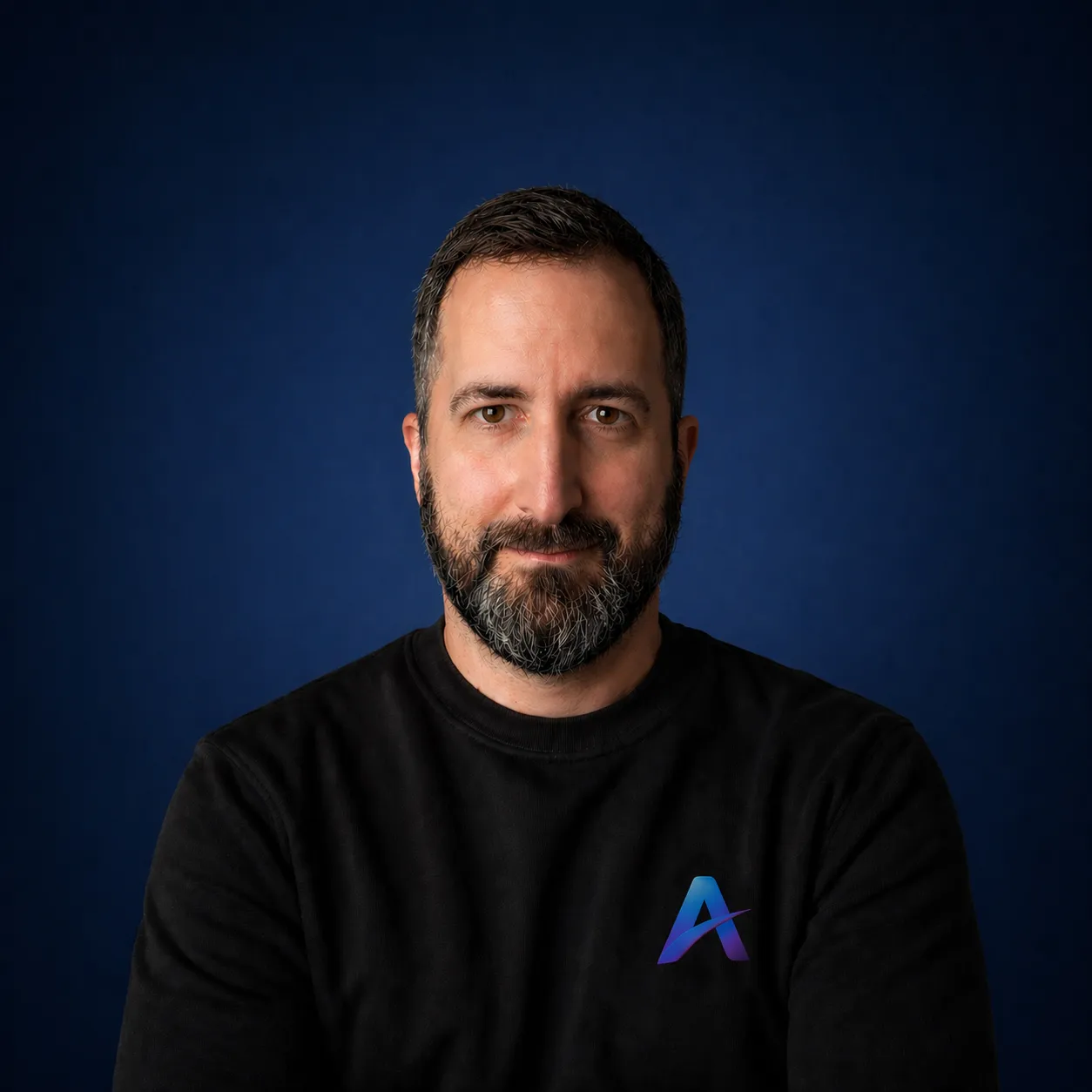
My path was not shaped by a traditional academic mould. I hold a degree in software development, but school and I never really worked together over the long run. I learned fast, often with ease, but I never quite felt in the right place. Technology, however, entered my life very early: my uncle, a collector and passionate Apple enthusiast, passed that world on to me as a child. I got my first Mac at 10, then started coding at 11 in BASIC on a Thomson TO7. Still, it was only when I entered the professional world that things truly clicked: concrete problems, operational constraints, teams, incidents, and products that have to work for real users.
I started in operations for several years, working on critical mobile telephony platforms at Orange, before moving into team leadership. That first chapter gave me a strong culture of reliability, responsibility and systems that cannot afford to fail. I later moved into innovation, as Product Manager and Product Designer for an internal tool linked to mobile app store submissions. That is where my Apple story came back to the centre: discovering iOS development through a colleague and friend who was an expert in the field, then learning Swift on my own. After once promising myself I would never become a developer, I realised this craft could also be a place of creation, precision and joy.
Things accelerated in streaming. At OCS, then Molotov TV and CANAL+, I worked on apps used at scale, with strong expectations around quality, performance and user experience. I led mobile, web, TV and backend teams, drove full rebuilds, improved architectures, built video players, and worked alongside designers, product managers and developers with one shared goal: shipping products that are more robust, easier to evolve and more enjoyable to use.
For a long time, I had personal app ideas without taking the time to build them. The arrival of AI changed that balance. It helped me move faster, prototype, iterate and, most importantly, respond to needs very close to home. MyMediBox was born that way: an app designed to help my wife in her daily life, so she would not forget her medication, renewals, and all the details that make health management heavier than it should be.
Alivency was born from that crossing point: hands-on experience built in demanding environments, a passion for well-crafted digital products, and the desire to turn useful ideas into concrete applications. At 42, I chose to open a new page and start an entrepreneurial journey with an independent studio, able to create its own products while supporting teams on ambitious technical challenges, as I do today with BeReal.
Years spent on critical platforms, large-scale streaming apps and demanding product teams shaped a simple approach: build what is useful, robust, maintainable and shippable.
A good technical decision starts with what it makes possible for users, the team and the product.
Readability, tests, observability, architecture: every detail matters when a product is meant to last.
Build solid enough to evolve, simple enough to understand and flexible enough to absorb reality.
Move through readable increments, make trade-offs explicit and keep a trajectory everyone can follow.
A successful engagement is not only measured at launch, but by what the team can still do afterwards.
Pairing, reviews, architecture, knowledge sharing: expertise should stay with the team, not only in the deliverable.
Alivency builds its own applications and also supports teams on demanding product and technical challenges. If an idea, a need or a collaboration is worth exploring, let's simply start with a conversation.